

LIMR HAIM NEWS PEOPLE

Congratulations Abigail Connor
Abi Connor has secured a Communication and Engagement grant from the British Society for Immunology to create a card game aimed at A Level biology students. Abi designed the cards in partnership with Magpie, a Leeds-based creative agency, and they were printed by the University of Leeds Print and Copy Bureau.
Immunotrumps comprises playing cards featuring key immunology concepts and career cards that feature related science careers. So far it has been distributed to local schools and sixth form colleges and has also featured at the University of Leeds Be Curious festival. Please get in touch with Abi Connor if you'd like to hear more about this project.

Welcome back Tamara Humphries
Tamara has completed a three-month Science Policy Internship at the Academy of Medical Sciences through the MRC Policy Internship Scheme.
Asked about her experience, Tamara says, "I primarily worked on the Academy’s flagship Prevention project, supporting the NHS’s shift from treatment to prevention. This involved reviewing current UK prevention programmes, identifying gaps, and engaging with experts across fields such as health economics and infectious diseases to explore key challenges and opportunities."
"I also supported an industry-focused preclinical trials workshop, a programme on patient and public involvement, and worked on Horizon Europe. The experience strengthened my communication and critical thinking skills, while providing valuable insight into how science informs policy and impacts public health."
Tamara will now continue her PhD studies in the Samson lab. We are glad you had a great experience at AMS, and really pleased to have you back!
Welcome to our MSc project cohort of 2026
This year seven students from MSc Molecular Medicine and MSc Cancer Biology and Therapy cohort have selected research projects supervised by HAIM academics. Welcome!! We wish you every success with your projects.
You can read more about their projects below.
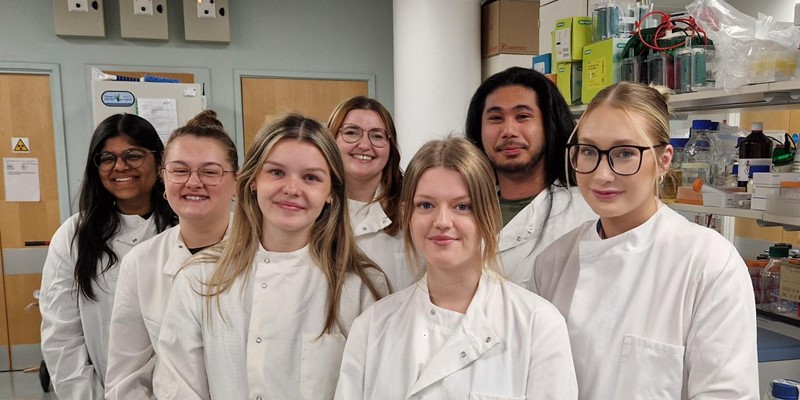
Pictured left to right: Muskaan Bohra, Isabella Atteck, Catriona Cunningham, Maria Burr, Tilly Cast, Kieran Bacalando and Tamzin Brown.
Isabella Atteck
Supervisor: Dr Salvatore Papa
Title: The Regulation of Metabolism on Drug Response in Multiple Myeloma
Summary: This project investigates how the reprogramming of metabolic pathways influences drug response in multiple myeloma. Resistance to chemotherapy remains a major challenge in cancer treatment, and altered metabolism is increasingly recognized as a key contributor to this process. The study aims to evaluate potential therapeutic agents targeting specific metabolic pathways and determine how its targeting enhance drug sensitivity in myeloma cells. Using molecular and biochemical approaches, metabolic pathways will be modulated to assess its effects on drug sensitivity, alongside evaluating candidate therapeutic agents to identify new strategies to overcome treatment resistance.
Tilly Cast
Supervisor: Prof Ulf Klein
Title: Exploring CD8+ T cell Biology in Multiple Myeloma for Improving Immunotherapy
Summary: This project investigates how the cytokine IL-27 modulates CD8+ T cell function in multiple myeloma, a disease characterised by immune dysfunction and therapeutic resistance. Given the reliance of modern immunotherapies on effective cytotoxic T cells, the study focuses on whether IL-27 can enhance CD8+ T cell activation, cytokine production, and cytotoxic capacity, while limiting features of T cell exhaustion. The project aims to investigate the extent to which IL-27 modulates the functional properties of CD8+ T cells, including cytokine responsiveness and production and cytotoxic activity, and to determine whether IL-27 influences molecular features associated with T cell exhaustion in myeloma cells, as has been described for CD8+ T cells in solid tumours.
Kieran Bacalando
Supervisor: Prof Reuben Tooze
Title: Built to Protect: How Plasma Cells Organise Themselves to Make Antibodies and How This May Go Wrong
Summary: Immunity to infection depends on production of antibodies that protect from disease. Antibodies are produced by specialised antibody-secreting plasma cells that are generated from B-cells. We don’t know how these plasma cells organise their own structure to become an efficient antibody factory, however the centrosome acts as a structural organising centre in other cell types. This project aims to understand the role of the centrosome in the formation and the function of plasma cells. Exploring this fundamental question may also elucidate how centrosome errors contribute to the generation of malignancies such as multiple myeloma.
Tamzin Brown
Supervisor: Dr Gina Doody
Title: MMSET Overdrive: Engineering Plasma Cell Transformation in a Myeloma Model
Summary: MMSET, also known as NSD2, is a histone-modifying enzyme that is overexpressed in a subset of multiple myeloma cases, resulting in aberrant expression of cell growth and survival genes. This project aims to investigate the effect of NSD2 in the development and function of plasma cells, by culturing and differentiating B cells to generate mature plasma cells, following introduction of NSD2 early in this process. I will then use flow cytometry, ELISAs and western blots to determine the significance of NSD2 expression in differentiating B cells.
Catriona Cunningham
Supervisor: Dr Alison Taylor
Title: The effects of GSK-3 inhibition on Natural Killer cell activity and degranulation
Summary: GSK-3 is a serine/ threonine kinase that regulates multiple oncogenic and immune signalling pathways. Although inhibition of GSK-3 has been shown to enhance T-cell-mediated anti-tumour responses, its effects on natural killer (NK) cells remain comparatively unexplored. Therefore, this project aims to investigate the effects of GSK-3 inhibition on NK-cell activity, specifically activation and degranulation. Improving the understanding of how GSK-3 regulates NK-cell function will help clarify the potential of GSK-3 inhibitors as an immunotherapy in cancer.
Muskaan Bohra
Supervisor: Dr Robert Salmond
Title: Targeting tyrosine phosphatase in Hepatocellular Carcinoma
Summary: This project investigates the role of the protein tyrosine phosphatase SHP2 in hepatocellular carcinoma (HCC) and its potential as a therapeutic target. HCC is a highly aggressive liver cancer with limited treatment success due to tumour progression and immune suppression within the tumour microenvironment. The study aims to determine how SHP2 inhibition affects both tumour cell growth and anti-tumour immune responses. Murine and human HCC cell lines alongside T cell activation models, molecular and biochemical approaches will be used to evaluate the effects of SHP2 inhibitors on cancer cell proliferation, cytokine production, and immune signalling. The findings may identify new therapeutic strategies that combine SHP2 inhibition with immunotherapy to improve treatment responses in HCC.
Maria Burr
Supervisor: Dr Fiona Errington-Mais and Dr Richard Baugh
Title: Development of Immune Cell Engagers for Ewing Sarcoma Immunotherapy
Summary: Ewing Sarcoma is a rare paediatric bone and soft-tissue cancer with poor outcomes for patients with metastatic or relapsed disease. Existing immunotherapies have shown limited success, largely due to Ewing Sarcoma’s immunologically ‘cold’ microenvironment, which fails to generate an effective anti-tumour immune response. This project aims to investigate immune cell engagers (ICEs) that recognise CD3 on T cells and a tumour-associated antigen on Ewing Sarcoma cells, thereby physically bringing them together and stimulating T-cell-mediated killing independent of T-cell specificity. Using flow cytometry to analyse T-cell activation markers and tumour-cell viability, the aim is to evaluate the therapeutic potential of ICEs in Ewing Sarcoma.

Welcome to Yida Du
Yida has started his PhD under the supervision of Dr Fiona Errington-Mais and Dr Milene Volpato. Yida's project will investigate the reprogramming of tumour-associated macrophage following Eicosapentaenoic acid and reovirus treatment.
We wish you every success with your project.

Congratulations Dr Noura Alzamel
Noura recently completed her PhD under the supervision of Dr Fiona Errington-Mais, Dr Victoria Jennings, Prof Graham Cook and Dr Laura Matthews.
During her PhD project, Noura developed and characterised intrinsic and acquired drug resistant ovarian cancer models and investigated the efficacy of oncolytic virus therapy against drug resistant disease.
Noura has returned to work at Kuwait University to teach and develop an independent research group.

Double congratulations to Dr Richard Baugh
Richard recently presented a poster at the Advances In Ewing Sarcoma Research meeting in London, where he was awarded a prize for his work. He is pictured receiving his prize.
Richard also attended the Experimental Cancer Medicine Centres (ECMC) 2026 Junior Investigator Network Group meeting in Manchester, where he presented a hypothetical phase I clinical trial for immunotherapy for Ewing Sarcoma. He was awarded one of the 2026 JING Cohort Study Idea prizes. Keep up the excellent work!

Congratulations Dr Mengjiao (JoJo) Xia
JoJo has successfully completed her PhD, under the supervision of Dr Peter Laslo and Dr Laura Matthews.
JoJo's project investigated mechanisms underlying cancer treatment resistance using models of CML (Laslo) and Glioblastoma (Matthews).
JoJo has returned to China to start her first postdoctoral fellow position. Good luck JoJo!

Congratulations to Dr Huijun Xu
Huijun has successfully completed her PhD, under the superviosion of Dr Tyler Barr and Prof Graham Cook.
Huijun's project investigated the production of prostaglandin E2 (PGE2) in the tumour microenvironment and how PGE2 inhibits natural killer cells.
Well done Huijun!! We look forward to reading your papers.

Congratulations Dr Hanadi Qashqari
Hanadi Qashqari has successfully completed her PhD, under the supervision of Prof Graham Cook and Dr Laura Matthews.
Hanadi's project investigated how glucocorticoids modulate the efficacy of oncolytic viruses in the treatment of Glioblastoma.
Hanadi has now returned to Saudi Arabia to take up a lecturer post, and start her own research group. Good luck Hanadi!

Congratulations Dr Nametso Khumo
Nametso completed her PhD under the supervision of Dr Milene Volpato and Dr Fiona Errington-Mais.
Nametso's research project investigated the ability of Eicosapentaenoic acid to enhance reovirus immunotherapy, through modulation of the immunosuppressive tumour microenvironment.
Nametso has moved to London and joined UCB as a target validation and tractability scientist. We all wish you the best of luck in your new job.